Harvest 2025, the sumoll comes back

A promise for the future

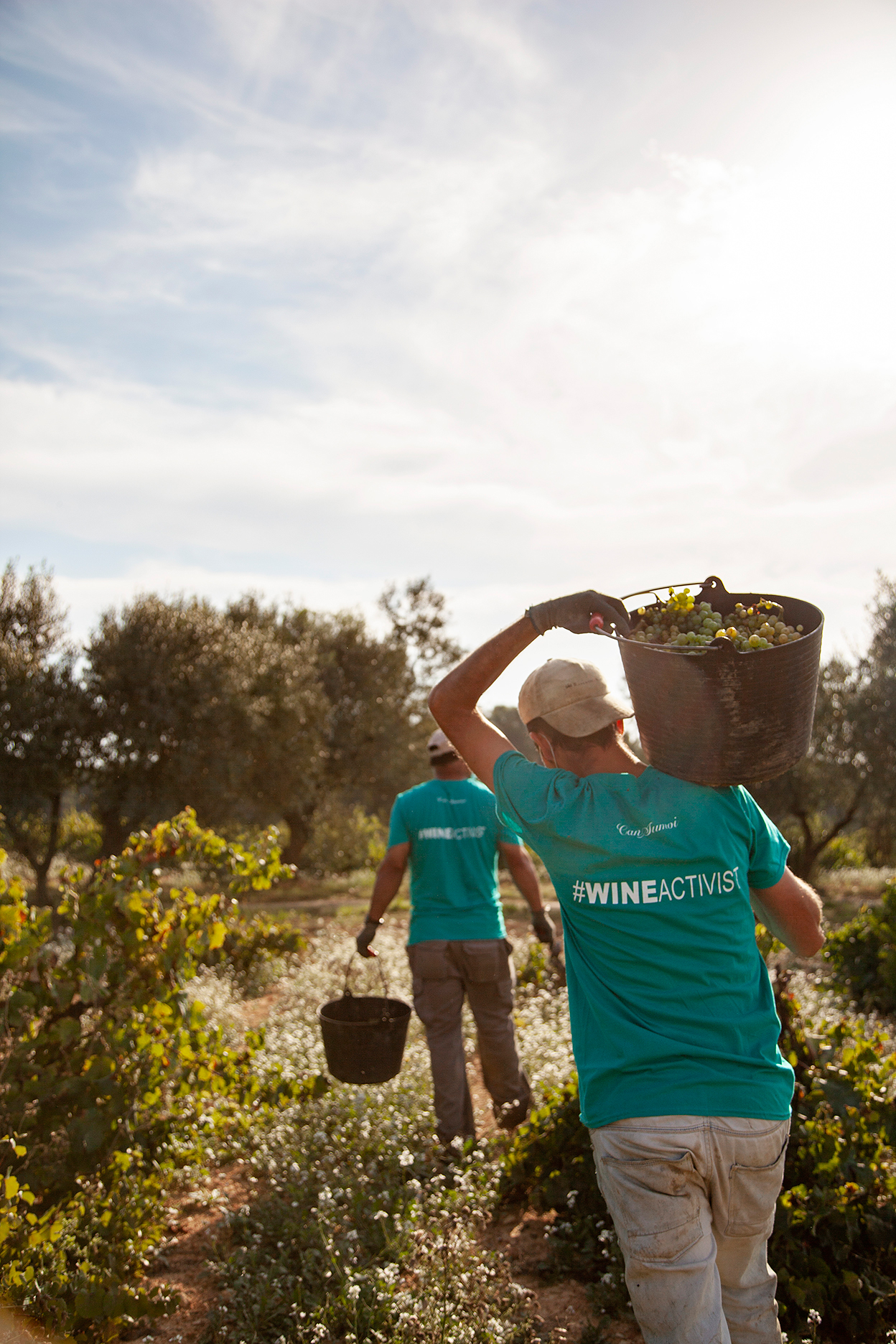
The harvest began on September 16th, after a warm and humid year that brought us 714 mm of rain. The water restored life to the fields, and the vines grew with strength and balance, yielding a healthy and promising crop.

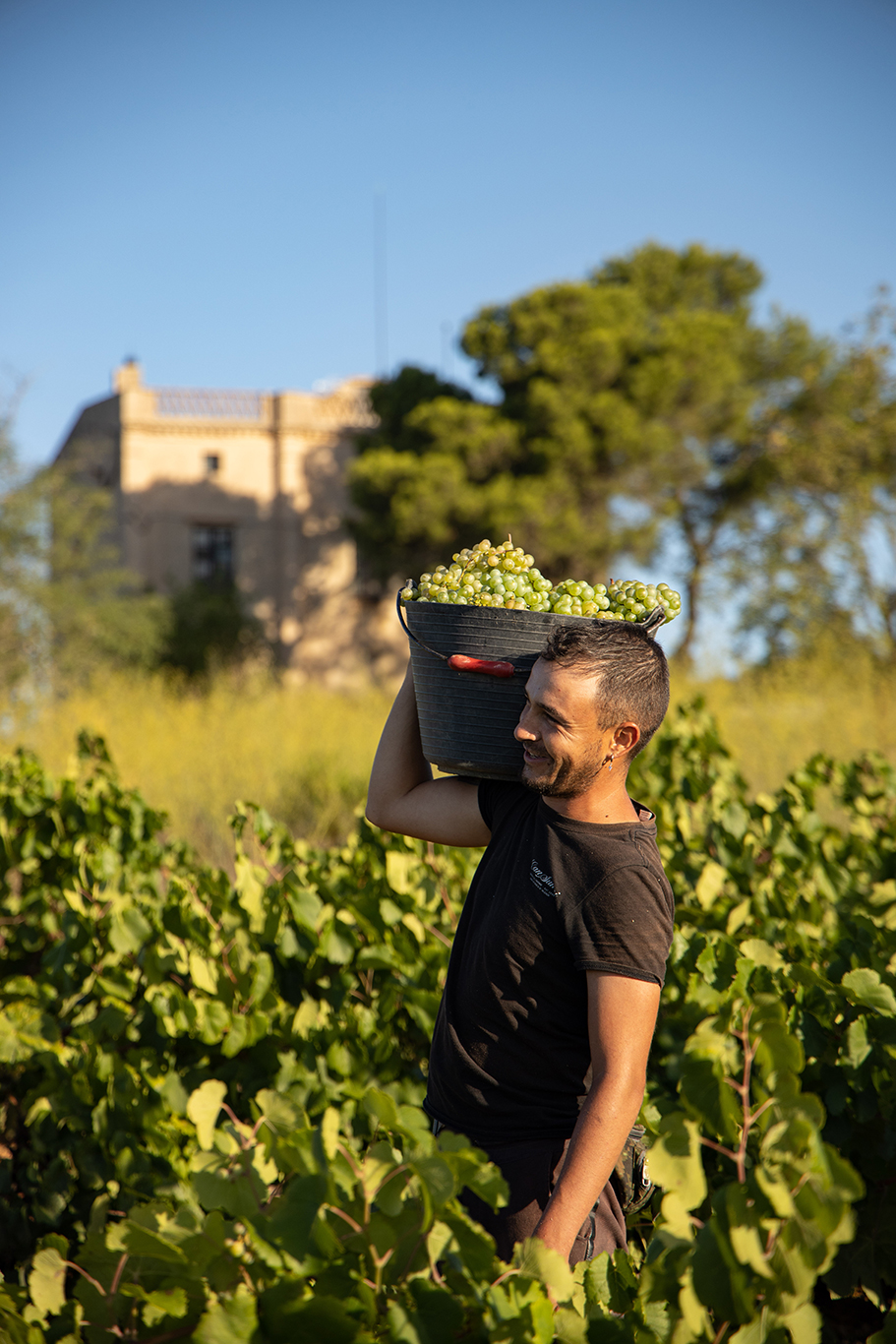
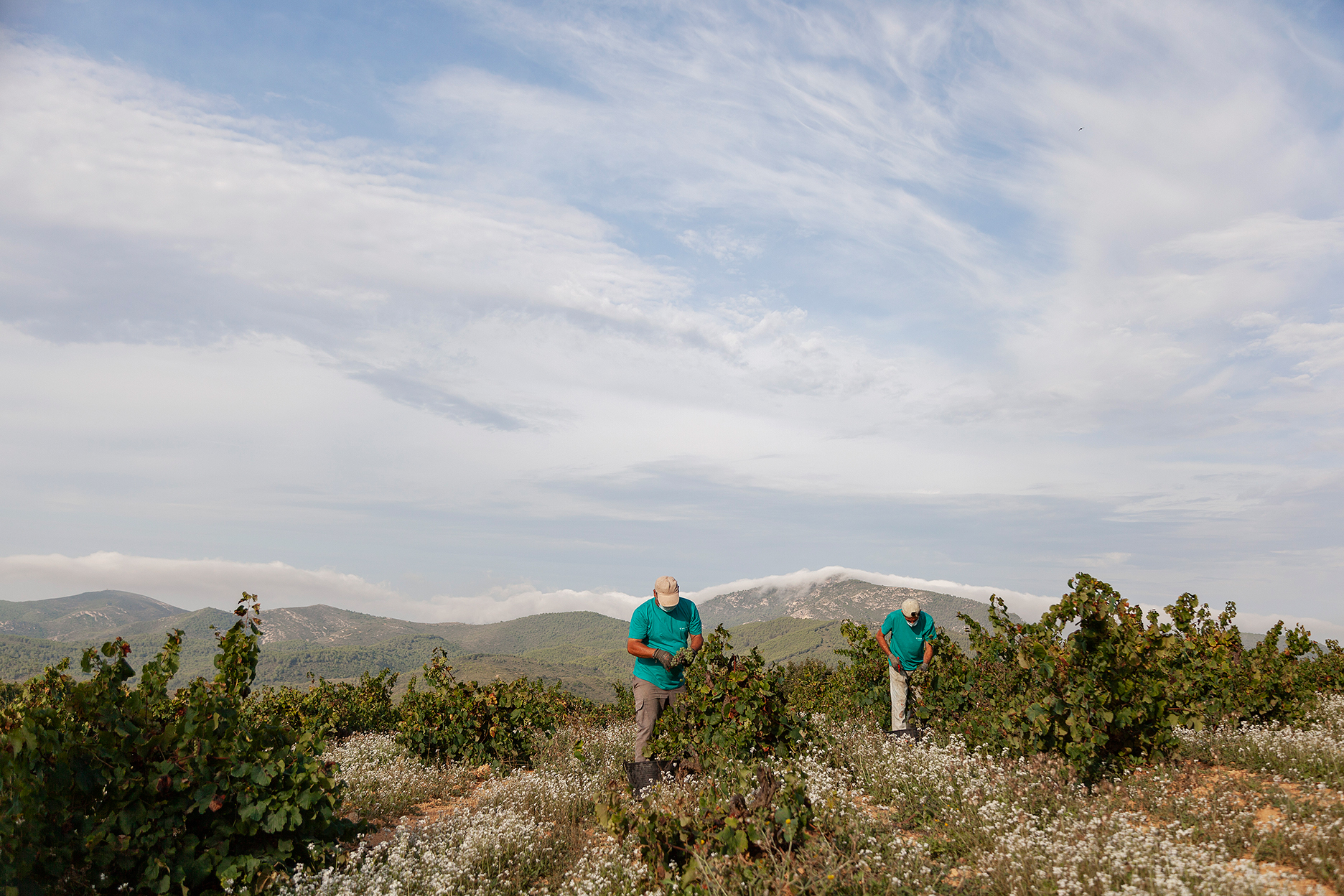
Twelve members of the team harvested the Can Sumoi vineyards, working among the vines under the watch of the Montmell. This harvest has been especially meaningful, as we picked the first sumoll grapes — five years after planting the first vines. Despite their youth, they already show great potential and have been used for La Rosa. A symbolic step that marks the return to the origin of a variety that gives its name to the estate and had not been cultivated here for over half a century.

As every year, we worked hand in hand with the region’s growers. The macabeu and xarel·lo from Aiguamúrcia and Les Pobles (400–500 m), grown by Pere Magre and Gerard Gallofré, have given life to the new Muntanya; the old xarel·lo from La Bisbal and Sant Martí Sarroca (350 m), from Joan Ferrando, Jaume Pons and Kiku Fernández, to the Xarel·lo. The high-altitude white grenache (500–700 m) from Querol and Pla de Manlleu, grown by Anna Llenas and Sergi Molinari, will form the base of the future vintage of Garnatxa Blanca. And the sumoll from Rodonyà, Montferri, Masllorenç and Montmell, together with the red grenache from Pla de Manlleu, from Joan Batalla, Antoni Mitjans and Joan Salvador, complete a diverse harvest with remarkable territorial expression.

The harvest came to an end on October 1st with the arrival of the last boxes of sumoll — closing a vintage that reminds us that patience and life in the vineyard always move at the same pace.

The Masoveria Returns to Can Sumoi

Rural Life Returns to the Estate

After years uninhabited, the Can Sumoi estate is once again full of life. We have brought back an essential figure from Catalan rural history: the masover —a caretaker who not only lived in the farmhouse but truly lived it, cared for it, and understood nature’s cycle.

At Can Sumoi, we’re delighted to welcome Alfred Ferrís, who now lives in the Masia de Baix with his family. He has moved in with his four mares, two donkeys, and two dogs. He will look after the animals, the vegetable garden, and the maintenance of the surroundings —small gestures that restore the natural rhythm of rural life to the estate.

Alfred is an agricultural engineer and one of Spain’s leading experts in animal traction applied to viticulture. He has worked with horses for over thirty-five years and has spent more than a decade dedicated entirely to soil management with draft animals. His arrival at Can Sumoi symbolizes a return to origins —a way of understanding the land through coexistence, respect, and memory.

Muntanya is Born

The First Traditional-Method Sparkling Wine

There are moments that mark a before and after. Muntanya 2024 is one of them —the first traditional-method sparkling wine from Can Sumoi, born in the highlands of Montmell.

To recover is to look at the land with respect, to listen to it, and to give it back its voice. Since 2017, we’ve been building close ties with farmers and vineyards in this often-forgotten corner of the Penedès, where vines grow surrounded by forest and silence. From this bond comes Muntanya: a high-altitude sparkling wine, fresh and balanced, that embodies the strength and purity of an austere yet vibrant landscape.

The blend —Macabeu and Xarel·lo— comes from vineyards located between 400 and 700 meters above sea level. It is a frank, vibrant expression of fruit, defined by the natural acidity of altitude and a fine, lively bubble.

With Muntanya, Can Sumoi begins a new chapter —a way to celebrate the land, the people who work it, and the memory of a Penedès that once again speaks with its own voice.

Recovery and Memory

The Cooperative Beats Again

La Vanguardia – “The Modernist Cooperative of Aiguamúrcia is on the Road to Revival”, by Rosa M. Bosch, September 2025

The article highlights, with great sensitivity, the depth and value of the project, focusing on the restoration of the Aiguamúrcia Cooperative, the collaboration with local winegrowers and farmers, the commitment to native varieties such as Sumoll, and the forest management initiatives —all efforts led to bring life back to the estate, the vineyard, and the surrounding woodland.

La Vanguardia also emphasizes the return of the masoveria (the traditional live-in caretaker) to the estate, a gesture that reconnects us with the region’s agricultural roots.

Journalist Rosa M. Bosch underlines the significance of the modernist building, noting that “the legacy of Cèsar Martinell (author of the Wine Cathedrals and disciple of Gaudí) in Aiguamúrcia will beat again 40 years later.” She also highlights the project’s strong community ties, pointing out that “this initiative brings together a commitment to the Sumoll grape variety and close collaboration with the local cooperative members and farmers.”

We are proud to see this path we are building together gain recognition in leading media outlets, reaffirming Can Sumoi as a winegrowing project with real impact on both the land and the community

We recovered the Cooperative of Aiguamúrcia

Our new winery

In June 2025, we have recovered the old Aiguamúrcia Cooperative, which had been silent for more than forty years, to convert it into our new winery and vinify our minimal intervention wines there. The building was constructed at the beginning of the 20th century by the architect Cèsar Martinell, a disciple of Gaudí and one of the most relevant figures of Catalan agricultural cooperativism. Today it is considered Historical and Cultural Heritage of Catalonia. This new space, located at the foot of Montmell, will allow us to vinify much closer to our vineyards and continue to reinforce our commitment to minimal intervention viticulture and to local winegrowers.

This new space, located at the foot of Montmell, will allow us to vinify much closer to our vineyards and continue to reinforce our commitment to minimal intervention viticulture and local winegrowers.

As Pepe Raventós explains, "it is a step that is consistent with our way of working: to be closer to the field in order to take care of it in the best possible way, and to build a project where everyone - from the winegrowers to the winemakers, distributors and customers - feels involved and respected."

Animal traction

We care for the land with respect

We have incorporated animal traction in some of Can Sumoi's vineyards. This is an ancestral practice that allows us to take care of the land and the vineyards in a more respectful and regenerative way.

Specifically, we work three small terraces with our Breton horses, as they have a narrow planting frame and through this technique we can care for them more carefully.

In addition, by using horses instead of heavy machinery, we reduce soil compaction, preserve its living balance and promote the overall health of the vineyard. We also contribute to reducing emissions and remain consistent with our values.

This decision is part of the Can Sumoi recovery project that Pepe Raventós initiated in 2017: to make the estate a living organism again, with animals, polyculture, biodiversity and the figure of the masovero.

Going back to the origins is, for us, a way of honoring the work of past generations and continuing to build a project rooted in biodynamics, natural wine and deep respect for the land.

Commitment to the territory

A fair price for grapes

-Diari de Tarragona: “We will create a great world wine with the sumoll”, Sílvia Fornós, September 2024-

“Of all our work, the most beautiful thing is to pay the right price for each kilo of grapes so that it is returned to the territory”, says Pepe Raventós in this page-and-a-half interview to remind us of the importance of the work of the local winegrowers we work with.

During their visit to the estate, the team of this historic headline was captivated by the nature that surrounds the place and the work we are doing on it, bringing the estate back to life, restoring the farmhouses and working to “make a great world wine with sumoll. The sumoll returns to Can Sumoi, a sign of where we come from and where we can go”.

Can Sumoi

One of the top 100 wineries in the world

- Top 100 Wineries by Wine & Spirits, 2022 & 2023 -

We are proud to announce that Can Sumoi has once again been named as one of the top 100 wineries in the world, by the prestigious American magazine, Wine & Spirits.

This is the second consecutive year that we have been included in this exclusive list, in which very few wineries have the honour to appear, let alone repeat.

On this occasion, our wines La Rosa 2022 (96 points) and Xarel·lo 2022 (94 points) were the most valued by the wine tasting team of the publication, helping us to position on the global stage wines originating from the Penedès region and the varieties xarel·lo y sumoll.

A great achievement that we hope to repeat in future years!

Native grapes

And maverik spirit

-Noble Rot “Catalonia Dreaming” Dan Keeling, March 2020-

The most alternative British magazine in the world of wine has dedicated an article to our estate and our wines. The co-founder and editor himself, Dan Keeling, was very impressed with everything about Can Sumoi. This is just a short extract of a four-page report published in this renowned magazine.

“Part of what makes Can Sumoi such an exciting prospect is not only the rebirth of a long-forgotten inheritance – a tendency in all Spanish wine – but also the ambition of elevating a grape not conventionally regarded as capable of greatness.”

A harvest

600 m above sea level

The altitude of our estate means that the harvest is later than in the lower areas of the Penedés. This year, 2023, we started harvesting on 6 September, collecting our ten hectares of montonega and harvesting the last bunches of sumoll on 13 September.

It was a complicated harvest. The drought (it only rained 350 L/m2) and constant attacks from wild boar and roe deer, meant that our team had to work ceaselessly to obtain the maximum amount of fruit from our vines, and even so, production was about 40% less than in 2022.

The other side of the coin is the quality of the grape, with very good levels of acidity and excellent health, which is ideal for making our natural wines.

Sumoll

New planting

In April 2022, in our desire to recover local varieties on the estate, our team of winegrowers dedicated much of their efforts to replanting sumoll on the estate.

We have recovered nine small terraces (2 ha in total) with different aspects to locate these goblet-trained strains, which is the traditional method that allows us to protect the grape better from climate change.

It is exciting to feel that we have given the estate new life and that we are doing so with a native variety with which we dream of making great wines. Before then, we will have to wait, since this new planting will not begin to bear fruit until the 2026 harvest.

Contemporary wines

From ancient Catalan vines

-Wine&Spirits “Contemporary wines from ancient Catalan vines” Patricio Tapia, August 2019-

Wine&Spirits Magazine published a report in which it unveils to its readers the passion that led us to discover this estate and recover its vineyards. Enthralled by our old xarel·los and the views of the Mediterranean Sea, Patricio Tapia describes it like this:

“An equally singular landscape enchanted Pepe Raventós (…) the first time he saw it. (…) An abandoned vineyard, about 50 acres of old-vine parellada, xarel·lo and sumoll. (…) Raventós was fascinated by the place and found records of the estate dating back to the seventeenth century, when it was known as Can Sumoi.”

Harvest 2025, the sumoll comes back

A promise for the future

The harvest began on September 16th, after a warm and humid year that brought us 714 mm of rain. The water restored life to the fields, and the vines grew with strength and balance, yielding a healthy and promising crop.

Twelve members of the team harvested the Can Sumoi vineyards, working among the vines under the watch of the Montmell. This harvest has been especially meaningful, as we picked the first sumoll grapes — five years after planting the first vines. Despite their youth, they already show great potential and have been used for La Rosa. A symbolic step that marks the return to the origin of a variety that gives its name to the estate and had not been cultivated here for over half a century.

As every year, we worked hand in hand with the region’s growers. The macabeu and xarel·lo from Aiguamúrcia and Les Pobles (400–500 m), grown by Pere Magre and Gerard Gallofré, have given life to the new Muntanya; the old xarel·lo from La Bisbal and Sant Martí Sarroca (350 m), from Joan Ferrando, Jaume Pons and Kiku Fernández, to the Xarel·lo. The high-altitude white grenache (500–700 m) from Querol and Pla de Manlleu, grown by Anna Llenas and Sergi Molinari, will form the base of the future vintage of Garnatxa Blanca. And the sumoll from Rodonyà, Montferri, Masllorenç and Montmell, together with the red grenache from Pla de Manlleu, from Joan Batalla, Antoni Mitjans and Joan Salvador, complete a diverse harvest with remarkable territorial expression.

The harvest came to an end on October 1st with the arrival of the last boxes of sumoll — closing a vintage that reminds us that patience and life in the vineyard always move at the same pace.

The Masoveria Returns to Can Sumoi

Rural Life Returns to the Estate

After years uninhabited, the Can Sumoi estate is once again full of life. We have brought back an essential figure from Catalan rural history: the masover —a caretaker who not only lived in the farmhouse but truly lived it, cared for it, and understood nature’s cycle.

At Can Sumoi, we’re delighted to welcome Alfred Ferrís, who now lives in the Masia de Baix with his family. He has moved in with his four mares, two donkeys, and two dogs. He will look after the animals, the vegetable garden, and the maintenance of the surroundings —small gestures that restore the natural rhythm of rural life to the estate.

Alfred is an agricultural engineer and one of Spain’s leading experts in animal traction applied to viticulture. He has worked with horses for over thirty-five years and has spent more than a decade dedicated entirely to soil management with draft animals. His arrival at Can Sumoi symbolizes a return to origins —a way of understanding the land through coexistence, respect, and memory.

Muntanya is Born

The First Traditional-Method Sparkling Wine

There are moments that mark a before and after. Muntanya 2024 is one of them —the first traditional-method sparkling wine from Can Sumoi, born in the highlands of Montmell.

To recover is to look at the land with respect, to listen to it, and to give it back its voice. Since 2017, we’ve been building close ties with farmers and vineyards in this often-forgotten corner of the Penedès, where vines grow surrounded by forest and silence. From this bond comes Muntanya: a high-altitude sparkling wine, fresh and balanced, that embodies the strength and purity of an austere yet vibrant landscape.

The blend —Macabeu and Xarel·lo— comes from vineyards located between 400 and 700 meters above sea level. It is a frank, vibrant expression of fruit, defined by the natural acidity of altitude and a fine, lively bubble.

With Muntanya, Can Sumoi begins a new chapter —a way to celebrate the land, the people who work it, and the memory of a Penedès that once again speaks with its own voice.

Discover it

Recovery and Memory

The Cooperative Beats Again

La Vanguardia – “The Modernist Cooperative of Aiguamúrcia is on the Road to Revival”, by Rosa M. Bosch, September 2025

The article highlights, with great sensitivity, the depth and value of the project, focusing on the restoration of the Aiguamúrcia Cooperative, the collaboration with local winegrowers and farmers, the commitment to native varieties such as Sumoll, and the forest management initiatives —all efforts led to bring life back to the estate, the vineyard, and the surrounding woodland.

La Vanguardia also emphasizes the return of the masoveria (the traditional live-in caretaker) to the estate, a gesture that reconnects us with the region’s agricultural roots.

Journalist Rosa M. Bosch underlines the significance of the modernist building, noting that “the legacy of Cèsar Martinell (author of the Wine Cathedrals and disciple of Gaudí) in Aiguamúrcia will beat again 40 years later.” She also highlights the project’s strong community ties, pointing out that “this initiative brings together a commitment to the Sumoll grape variety and close collaboration with the local cooperative members and farmers.”

We are proud to see this path we are building together gain recognition in leading media outlets, reaffirming Can Sumoi as a winegrowing project with real impact on both the land and the community

Read the full article

We recovered the Cooperative of Aiguamúrcia

Our new winery

In June 2025, we have recovered the old Aiguamúrcia Cooperative, which had been silent for more than forty years, to convert it into our new winery and vinify our minimal intervention wines there. The building was constructed at the beginning of the 20th century by the architect Cèsar Martinell, a disciple of Gaudí and one of the most relevant figures of Catalan agricultural cooperativism. Today it is considered Historical and Cultural Heritage of Catalonia. This new space, located at the foot of Montmell, will allow us to vinify much closer to our vineyards and continue to reinforce our commitment to minimal intervention viticulture and to local winegrowers.

This new space, located at the foot of Montmell, will allow us to vinify much closer to our vineyards and continue to reinforce our commitment to minimal intervention viticulture and local winegrowers.

As Pepe Raventós explains, "it is a step that is consistent with our way of working: to be closer to the field in order to take care of it in the best possible way, and to build a project where everyone - from the winegrowers to the winemakers, distributors and customers - feels involved and respected."

Read the full article

Animal traction

We care for the land with respect

We have incorporated animal traction in some of Can Sumoi's vineyards. This is an ancestral practice that allows us to take care of the land and the vineyards in a more respectful and regenerative way.

Specifically, we work three small terraces with our Breton horses, as they have a narrow planting frame and through this technique we can care for them more carefully.

In addition, by using horses instead of heavy machinery, we reduce soil compaction, preserve its living balance and promote the overall health of the vineyard. We also contribute to reducing emissions and remain consistent with our values.

This decision is part of the Can Sumoi recovery project that Pepe Raventós initiated in 2017: to make the estate a living organism again, with animals, polyculture, biodiversity and the figure of the masovero.

Going back to the origins is, for us, a way of honoring the work of past generations and continuing to build a project rooted in biodynamics, natural wine and deep respect for the land.

Commitment to the territory

A fair price for grapes

-Diari de Tarragona: “We will create a great world wine with the sumoll”, Sílvia Fornós, September 2024-

“Of all our work, the most beautiful thing is to pay the right price for each kilo of grapes so that it is returned to the territory”, says Pepe Raventós in this page-and-a-half interview to remind us of the importance of the work of the local winegrowers we work with.

During their visit to the estate, the team of this historic headline was captivated by the nature that surrounds the place and the work we are doing on it, bringing the estate back to life, restoring the farmhouses and working to “make a great world wine with sumoll. The sumoll returns to Can Sumoi, a sign of where we come from and where we can go”.

Read the full article

Can Sumoi

One of the top 100 wineries in the world

- Top 100 Wineries by Wine & Spirits, 2022 & 2023 -

We are proud to announce that Can Sumoi has once again been named as one of the top 100 wineries in the world, by the prestigious American magazine, Wine & Spirits.

This is the second consecutive year that we have been included in this exclusive list, in which very few wineries have the honour to appear, let alone repeat.

On this occasion, our wines La Rosa 2022 (96 points) and Xarel·lo 2022 (94 points) were the most valued by the wine tasting team of the publication, helping us to position on the global stage wines originating from the Penedès region and the varieties xarel·lo y sumoll.

A great achievement that we hope to repeat in future years!

See the list of the Top 100

Native grapes

And maverik spirit

The most alternative British magazine in the world of wine has dedicated an article to our estate and our wines. The co-founder and editor himself, Dan Keeling, was very impressed with everything about Can Sumoi. This is just a short extract of a four-page report published in this renowned magazine.

“Part of what makes Can Sumoi such an exciting prospect is not only the rebirth of a long-forgotten inheritance – a tendency in all Spanish wine – but also the ambition of elevating a grape not conventionally regarded as capable of greatness.”

Find out more about his trip to Penedès

A harvest

600 m above sea level

The altitude of our estate means that the harvest is later than in the lower areas of the Penedés. This year, 2023, we started harvesting on 6 September, collecting our ten hectares of montonega and harvesting the last bunches of sumoll on 13 September.

It was a complicated harvest. The drought (it only rained 350 L/m2) and constant attacks from wild boar and roe deer, meant that our team had to work ceaselessly to obtain the maximum amount of fruit from our vines, and even so, production was about 40% less than in 2022.

The other side of the coin is the quality of the grape, with very good levels of acidity and excellent health, which is ideal for making our natural wines.

Sumoll

New planting

In April 2022, in our desire to recover local varieties on the estate, our team of winegrowers dedicated much of their efforts to replanting sumoll on the estate.

We have recovered nine small terraces (2 ha in total) with different aspects to locate these goblet-trained strains, which is the traditional method that allows us to protect the grape better from climate change.

It is exciting to feel that we have given the estate new life and that we are doing so with a native variety with which we dream of making great wines. Before then, we will have to wait, since this new planting will not begin to bear fruit until the 2026 harvest.

Contemporary wines

From ancient Catalan vines

Wine&Spirits Magazine published a report in which it unveils to its readers the passion that led us to discover this estate and recover its vineyards. Enthralled by our old xarel·los and the views of the Mediterranean Sea, Patricio Tapia describes it like this:

“An equally singular landscape enchanted Pepe Raventós (…) the first time he saw it. (…) An abandoned vineyard, about 50 acres of old-vine parellada, xarel·lo and sumoll. (…) Raventós was fascinated by the place and found records of the estate dating back to the seventeenth century, when it was known as Can Sumoi.”

Our history in an article